Realisation Infrastructure
The category page: what Realisation Infrastructure is, the problem it exists for, the three loops and the constitution, the lexicon, and the evidence.
Civilisation's bottleneck is no longer invention. It is realisation. The most important ideas of our time are researched: plural technology, privacy-preserving data collaboration, organisational ambidexterity, AI that augments rather than replaces human cooperation. What is missing is the craft of making them real, in enterprises, in institutions, in democracies. Realisation Infrastructure names that craft as a category, so it can be built, measured and improved like any other infrastructure.
The problem it exists for
The literature calls this the Research-Practice Gap. I adopt the term and widen it: the same signature, knowledge present and behaviour unchanged, repeats at four scales, and at each scale a different bottleneck binds.
Knowledge-Doing Gap
Smart people who know what to do and do not do it. Bottleneck: embodiment. Only practice under pressure closes it.
Innovation-Realisation Gap
Firms that can recite ambidexterity and still fail at it. Bottleneck: the operating system. Only software installs.
Research-Practice Gap
Research and practice without a feedback loop at operational tempo. Bottleneck: feedback infrastructure.
Governance Gap
Validated democratic mechanisms that remain pilots. Bottleneck: constitutional embedding. Legitimacy is the slowest clock.
The three loops and the constitution
Dissemination does not close the gap; publishing, training and telling are demonstrably weak levers. Realisation is a capability of the receiving system. Realisation Infrastructure builds that capability at three tempos at once, and puts a constitution above them that decides where the surplus goes.
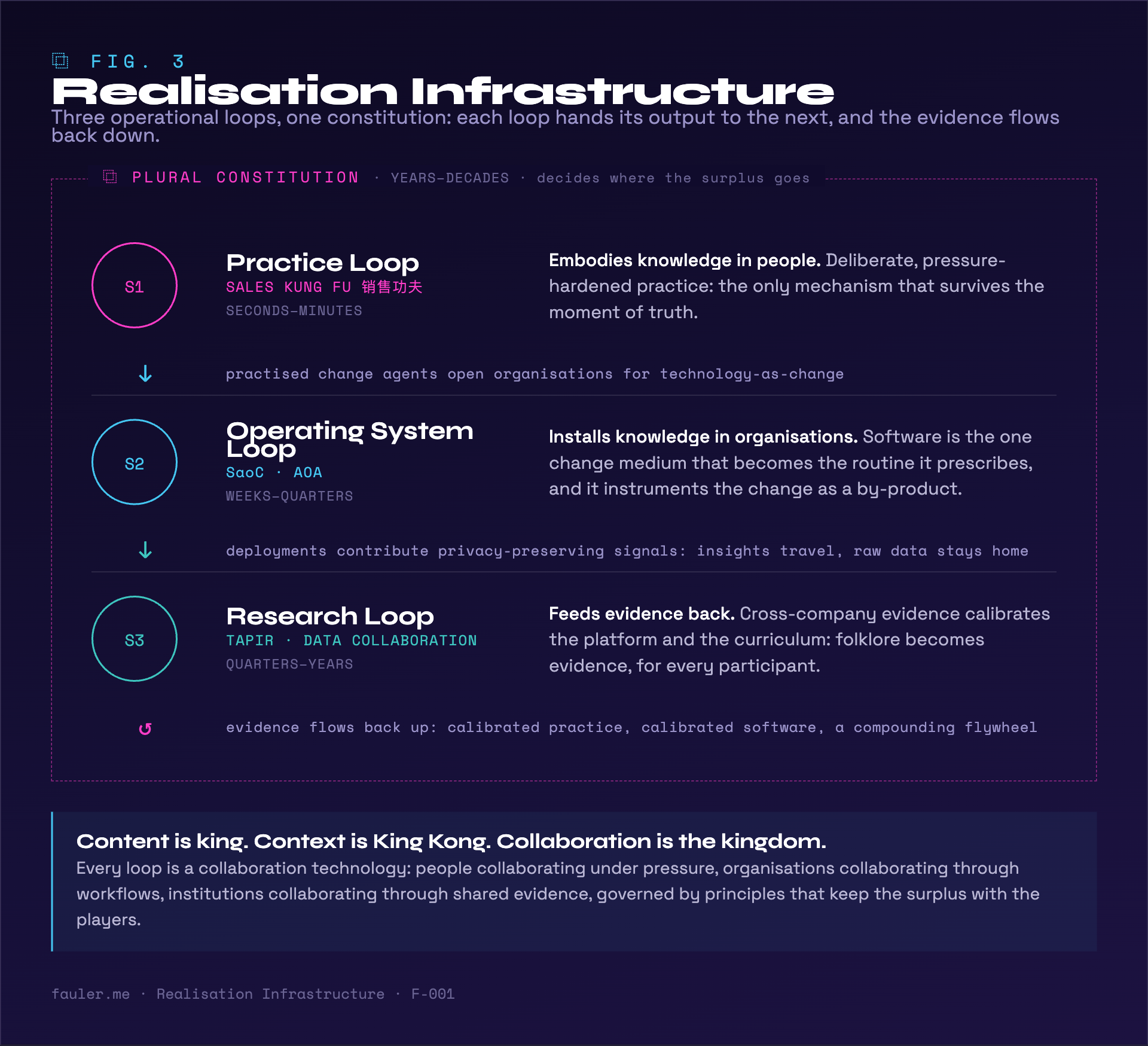
Embodies knowledge in people
Deliberate, pressure-hardened practice; the only mechanism that survives the moment of truth. Vehicle: Sales Kung Fu 销售功夫.
Installs knowledge into organisations
Software as organisational Change (SaoC): a guideline asks for compliance, a workflow is compliance. AOA measures whether it took hold. Vehicle: Kybernautik.
Feeds evidence back to research
Privacy-preserving data collaboration: institutions share knowledge, not data. Vehicle: Tapir, Data Collaboration.
Decides where the surplus goes
The ⿻ principles of RadicalxChange and Plurality: openness, agency, fairness, regenerativeness. By design, not by promise. Measured by the Plural Stack Assessment.
The test: where does the surplus go, and what is quietly taken?
Increasing returns and positive-sum have two faces. One face is monopolisation, intermediation and lock-in: every platform monopoly is positive-sum on paper while the intermediary captures the surplus. The other face is the one Realisation Infrastructure is built for: increasing returns that flow back to the players who create them, compounding capability instead of dependence. Any realisation flywheel with a data network effect faces this fork by construction. So the test has two halves, and a system must pass both.
Where does the surplus go?
To the players who create it, or to the middleman? Fair value sharing and joint governance decide this; a promise in the terms of service does not.
What is taken that never shows up in a price?
Extraction is not only monetary. Data, knowledge, attention, time and agency are siphoned just as quietly, and a fair split of the money can hide an unfair take of everything else. A plural system leaves these with their owners: no data taken beyond the purpose, no learning kept from the people who generated it, no attention harvested, no exit blocked.
The constitution is what keeps a system on the right side of both tests. Openness, Agency, Fairness, Regenerativeness are the properties; by design, not by promise, is the standard; the Plural Stack Assessment is the instrument that checks whether a service meets it.
The recursion test
Implementation science, founded to close the research-practice gap in healthcare, barely uses its own findings. I treat this as a design requirement: any serious attempt at the gap must explain why it will not reproduce the gap one level up. Realisation Infrastructure accepts the test. We practise our own Gates, deploy our own change, measure our own interventions, and publish what we learn, separating hypothesis from proof.
Lexicon
Categories are won by vocabulary. The terms below are used consistently across fauler.me; each has its own page in the Lexicon, with a citable one-sentence definition.
- Realisation Infrastructure · the machinery that turns validated knowledge into lived practice
- Research-Practice Gap (four scales) · one signature, four bottlenecks
- Practice Loop · embodiment through deliberate practice
- Operating System Loop · installation through software as organisational change
- Research Loop · evidence back to research, privacy-preserving
- Plural Constitution · the ⿻ rules that decide where the surplus goes
- SaoC · Software as organisational Change
- AOA · Ambidextrous Organisation Acceleration
- Data Collaboration · share knowledge, not data
- Two faces of increasing returns · compounding capability vs. compounding dependence; the test has two halves, distribution and extraction
- Bridger · carries concepts into production and evidence back into research
- Recursion test · a gap-closing system must close its own gap
Evidence and lineage
The argument is laid out in full, with 65 DOI-linked sources, in the founding essay. The lineage runs from Pfeffer and Sutton's Knowing-Doing Gap (2000) and Christensen's Innovator's Dilemma (1997) through implementation science (Bero et al., 1998; Boaz et al., 2024), organisational ambidexterity (O'Reilly and Tushman, 2013), deliberate practice (Ericsson et al., 1993), data collaboratives (Klievink et al., 2018) and the Plurality programme (Weyl, Tang and the ⿻ Community, 2024). What is new is not any single loop. It is the coupling, and the constitution above it.
Who this is for
If you lead an organisation that has read the research and still cannot execute it; if you sell technology and have understood that you are really selling organisational change; if you research ambidexterity, psychological safety or implementation and are tired of waiting 17 years for your findings to matter; if you design democratic mechanisms or plural technology and want them installed rather than piloted: you are exactly who this page is for. Not as an audience. As a co-creator, at whichever loop is yours.
Realisation Infrastructure · Definition v1.0 · First published 31 August 2026 · This page: September 2026 · Cite as: Fauler, A. (2026). Realisation Infrastructure. fauler.me/realisation-infrastructure · CC BY 4.0