Software as organisational Change
Why every software rollout, and every AI rollout above all, is a reorganisation in executable form, and what it takes to make it land.
The Question March Left Open
In 1991 James March asked a question that organisational science has not resolved since, namely how an organisation can exploit what it already knows while it explores what it does not know yet (March, 1991). The question was not rhetorical. It was existential, because organisations that only exploit die slowly and organisations that only explore die fast.
I read March’s question as a false either/or, and three decades of research back that reading. The answer has a name, organisational ambidexterity, which means the capacity to run today’s business and invent tomorrow’s at the same time (O’Reilly & Tushman, 2004, 2021). From Gibson and Birkinshaw (2004) to Raisch and Birkinshaw (2008), researchers have mapped the capabilities, structures and behaviours that separate ambidextrous organisations from the rest. Two calibrations keep the claim honest. The effect on performance is real but depends on context (Junni et al., 2013), and it works through innovation as the mediating engine rather than as a direct payoff (Marín-Idárraga et al., 2025).
So the knowledge exists, and the pressure exists too, as technology cycles compress and AI rewrites cost structures quarter by quarter. Still most organisations cannot translate the research into practice, because their primary purpose has always been to maintain the status quo and to repeat the success formulas of the past at scale. The Innovator’s Dilemma (Bower & Christensen, 1995; Christensen, 1997) is a story about well-run incumbents, which is exactly what makes it so uncomfortable.
Hagel and Brown (2017) gave the shift its most practical name. The DNA of successful organisations is “scalable for efficiency”, and what the environment now demands is “scalable for learning”, which means innovating from the edge and moving from exploitation-dominant to genuinely ambidextrous operating models. The open question is how. My answer is uncomfortable for both sides of every software contract, because the most powerful lever for that shift is already in the budget, and it is the software itself.
This field note is the companion essay to Realisation Infrastructure (F-001). There I argued that civilisation’s bottleneck has moved from invention to realisation, and that the gap between knowing and doing carries the same signature at four scales. Here I zoom into one of them, the organisation, where the gap lives in the operating system and where software is the medium that installs.
Software Is a Decision About How People Work
We still buy enterprise software as if it were a tool that sits on a shelf until someone picks it up, and that leaves the organisation as it found it. In reality it decides who approves, who sees, who waits and who is asked. Every rollout is a reorganisation, and most organisations do not notice that they voted for it.
The economic evidence is old and consistent. Bresnahan, Brynjolfsson and Hitt (2002) showed at firm level that information technology pays off when it comes bundled with changes in workplace organisation (decentralised decisions, new skills, redesigned work), and that it underperforms without these complements. Brynjolfsson, Rock and Syverson (2021) generalised the pattern into the Productivity J-Curve, in which general purpose technologies need large and mostly unmeasured investments in intangibles such as processes, skills and organisational design before they show up in productivity. The technology is the visible part. The organisational change is the larger part.
If that is true, the relevant question is whether the change is designed or accidental, because software changes the organisation in any case. I see four mechanisms through which software installs change, and each of them can be designed.
(1) Software distributes decision rights. Who can approve a discount, release a payment, escalate a case or close a ticket is written into the workflow first and into the organisation chart later, if at all. Bovens and Zouridis (2002) described what this does to public administration, which moves from street-level bureaucracy (a clerk exercises discretion at the counter) to system-level bureaucracy, where system designers and code decide. Lessig (1999) compressed the principle into three words, code is law.
(2) Software sets defaults, and what is pre-selected tends to happen. Madrian and Shea (2001) showed that automatic enrolment in a retirement plan raised participation substantially without changing a single incentive. Status quo bias (Samuelson & Zeckhauser, 1988), the strongest force against change in most organisations, turns into a lever for change the moment the default moves.
(3) Software makes things visible, and what is measured becomes negotiable. A dashboard that shows exploration time next to exploitation time changes a leadership meeting more than most workshops do, which is precisely why visibility meets resistance. Visibility moves power.
(4) Software rewires who talks to whom. A collaboration platform, a shared case file or a single routing rule changes the network through which information and influence flow, and since innovation travels through networks (more on that below), software is the cheapest way to redraw that network on purpose.
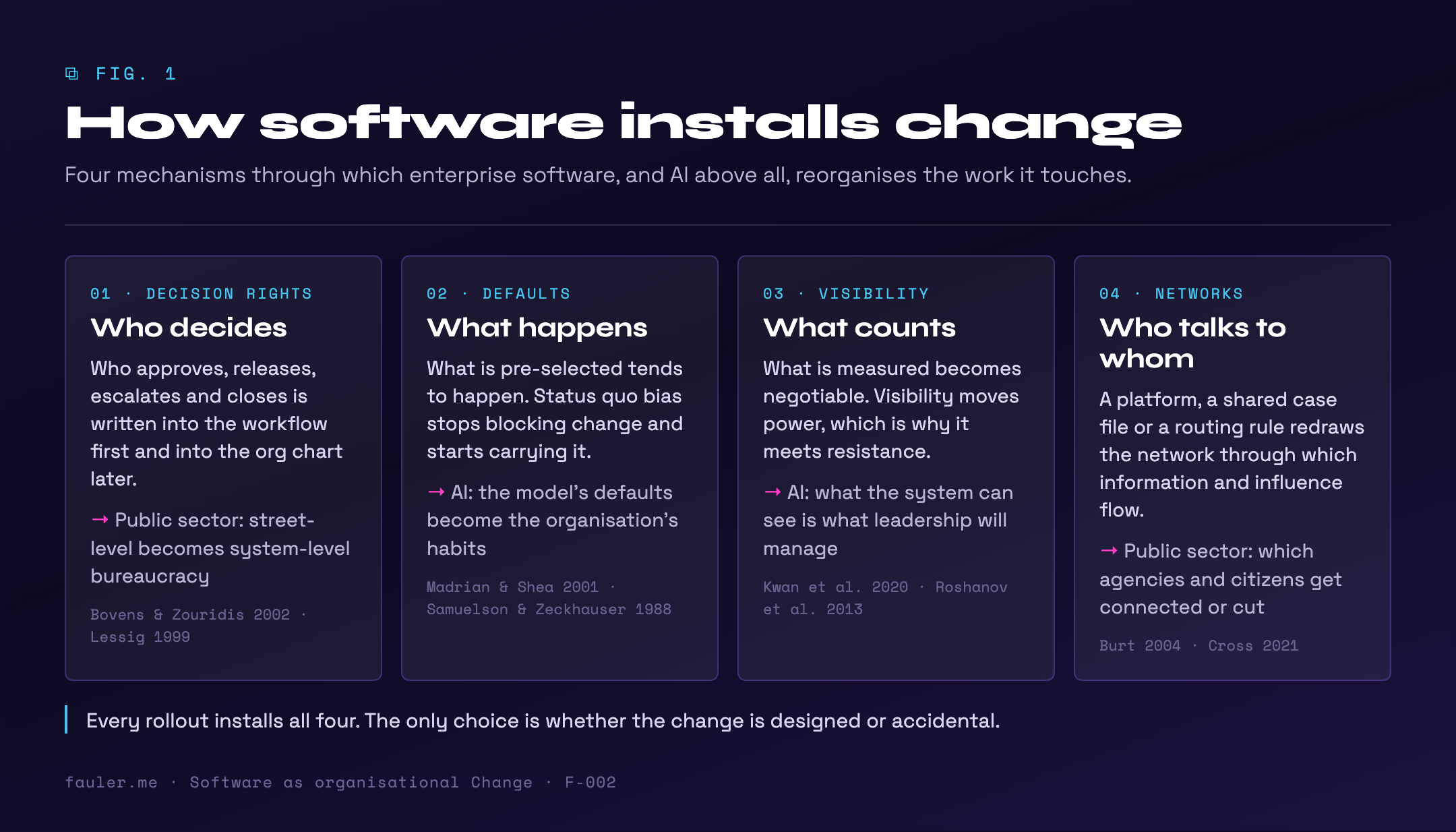
Medicine provides the cleanest proof that the principle works when it is designed. Clinical decision support embedded at the point of decision produces consistent improvements in care across hundreds of controlled trials (Kwan et al., 2020), and its effect depends on design, with advice placed inside the workflow at the moment of choice (Roshanov et al., 2013). A guideline asks for compliance, while a workflow already is compliance.
The software moment matters for a second reason, because it is the one moment when an organisation expects and budgets for behavioural change. Maples and Ziebelman (2024) call such moments inflections, external and usually technological changes that give change agents the power to alter how people think, feel and act. That is Wu Wei in practice.
AI Removes the Option to Look Away
For thirty years organisations could treat software as an IT topic and change as an HR topic. Generative AI ends that division of labour, because it is the first enterprise technology that does more than automate a process and takes part in the work itself.
The data show what happens when organisations ignore this. MIT’s Project NANDA reviewed more than 300 public AI initiatives, interviewed 52 organisations and surveyed 153 senior leaders, and concluded that about 95 percent of organisations get zero return from their generative AI investments (Challapally et al., 2025). The authors call their numbers directionally accurate and the method has drawn criticism, so I treat the figure as a strong signal and not as a law. Their diagnosis matters more. The core barrier is learning (tools that do not adapt to the workflow and organisations that do not adapt to the tools), which is the Productivity J-Curve in real time.
Where AI pays off, the gain sits in redesigned work. In one of the largest field studies so far, AI assistance raised the productivity of customer support agents by 15 percent on average, and the less experienced agents improved both the speed and the quality of their work (Brynjolfsson, Li & Raymond, 2025). The machine augmented the people, and it could do so only because the assistance was built into the conversation itself.
The European Union has drawn the conclusion in law. Since February 2025, Article 4 of the AI Act obliges every provider and deployer of AI systems to ensure a sufficient level of AI literacy among the staff who operate and use them (Regulation (EU) 2024/1689), so a technology regulation now mandates organisational learning.
Nowhere is this more consequential than in the public sector. AI accelerates the move from street-level to system-level bureaucracy that Bovens and Zouridis described two decades ago, so discretion that once sat with a case worker increasingly sits in a model, a rule engine and a default. Digital transformation in government, as Mergel, Edelmann and Haug (2019) found in their expert interviews, means redesigning processes, culture and the relationship with citizens, far beyond the digitisation of existing services. When a state buys AI, it rewrites how it exercises power. Public AI strategies that stop at procurement and pilots will meet the same 95 percent as everyone else, only with democratic consequences.
The same literature contains good news as well. Organisations in innovation ecosystems can share the burden of exploration with partners while keeping their own operations efficient, as Hietala and Päivärinta (2025) show for public digital service ecosystems. A state does not have to explore alone. It has to learn to orchestrate.
Ambidexterity Lives on Five Levels at Once
The challenge runs through nested levels, from individual capability through teams, business units and organisational design to the wider ecosystem (Simsek, 2009; Raisch & Birkinshaw, 2008). At the individual level ambidexterity depends on decision authority, cross-functional participation and access to diverse information (Mom, van den Bosch & Volberda, 2009), and at the team level psychological safety is the strongest known predictor of team learning (Edmondson, 1999, 2018). Business units face a hard structural choice between separating exploration from exploitation and embedding both in a shared context (O’Reilly & Tushman, 2004; Gibson & Birkinshaw, 2004). At the organisational level ambidextrous designs outperform pure exploitation or pure exploration under the right conditions (O’Reilly & Tushman, 2013), and at the ecosystem level exploration can be distributed across partners (Hietala & Päivärinta, 2025).
Read the list again with the four mechanisms in mind. Decision authority, access to information, structural separation and shared context are all things that software configures, whether anybody intends it or not.
These five levels nest inside the four scales of Realisation Infrastructure (the individual is scale 1, team to organisation form scale 2, the ecosystem is scale 3, and the polity at scale 4 is where the public sector meets the same pattern). Software is one of the few interventions that touches all of them at once.

Innovation Scales Through Networks of Agents
Scaling innovation is a story of communities in which people are both willing and able to innovate collectively. Hill, Brandeau, Truelove and Lineback (2014) showed that this needs creative abrasion (ideas through debate), creative agility (quick tests and adjustment) and creative resolution (integrative decisions that combine opposing ideas), and without this cultural foundation change initiatives stall, however much technology they carry.
I believe that networks of innovation agents can move large organisations (Kotter, 2014) once they reach critical mass and once a substantial technological innovation gives them a clear scope for change, and in my own engagements technology has repeatedly been the signal that told a population when and how to embrace change (Straub, Kuhnecke & Kirchmann, 2013).
Hill, Tedards and Wild (2026) extend this into three leadership roles. Architects build the internal culture and capabilities for co-creation, Bridgers forge partnerships across organisational walls, and Catalysts launch movements across companies, government and civil society. Technology that enables all three roles raises the odds of change at scale.
Three mechanisms decide whether these roles produce lasting impact. Leadership behaviour is the strongest lever, as Rosing, Frese and Bausch (2011) showed with ambidextrous leadership, the ability to switch between opening behaviours that encourage experimentation and closing behaviours that drive efficiency. Innovation also travels through informal networks, since a small share of well-connected employees carries a disproportionate part of change adoption (Cross, 2021) and people who bridge disconnected groups generate better ideas (Burt, 2004). And culture works as the operating system, because ambidextrous culture predicts new product innovation independently of structure (Wang & Rafiq, 2014), and a context that combines discipline, stretch, trust and support lets individuals decide for themselves how to divide their time between exploring and exploiting (Gibson & Birkinshaw, 2004).
The order matters. Build inward before you bridge outward, because Catalysts without Architects create movements that the organisation cannot absorb.

Influence Is a Loop
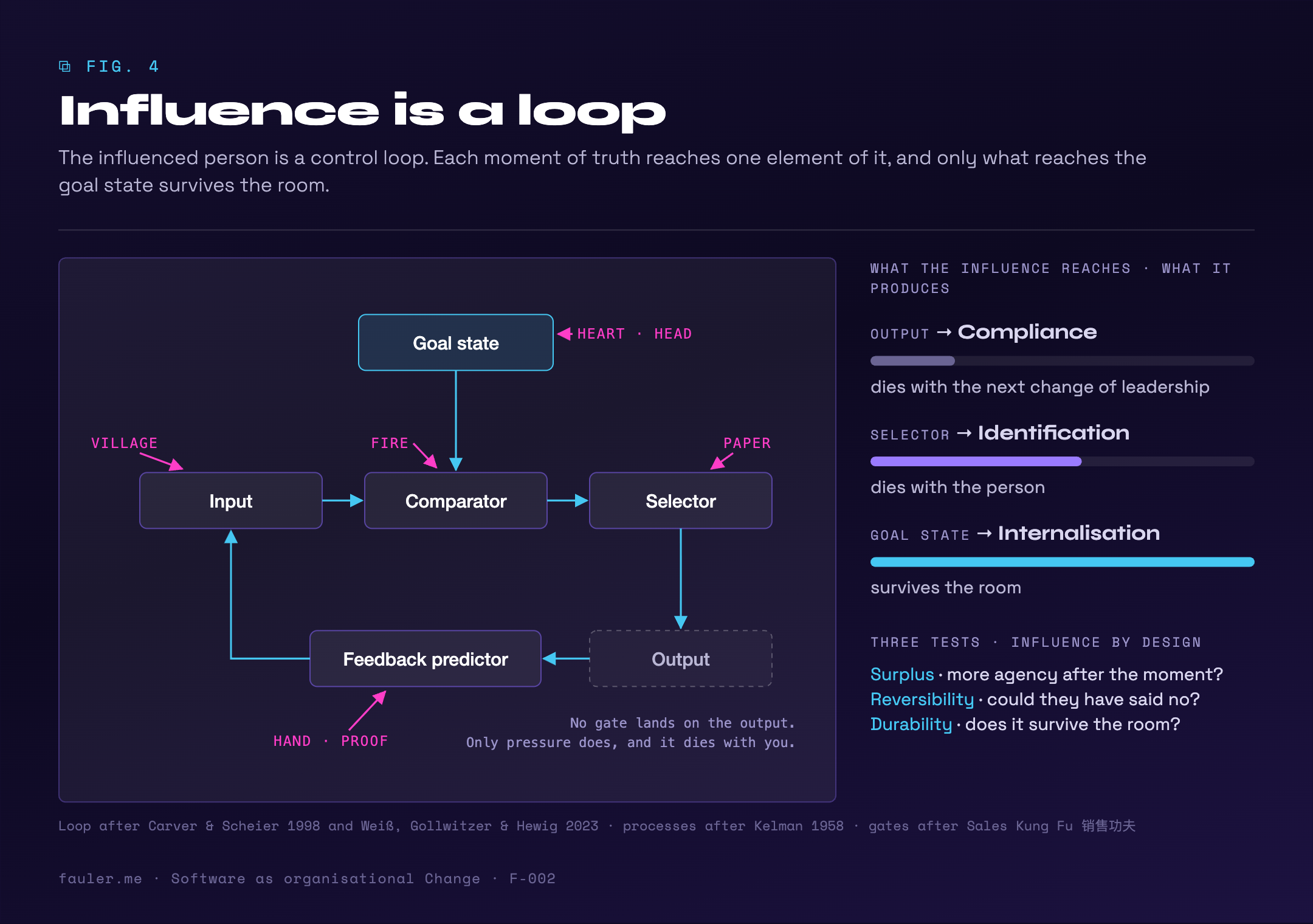
All three roles share one craft, and that craft is influence. The Architect influences a leadership team, the Bridger a buying group and the Catalyst a market or a polity, and in each case the decisive moment happens in a room, under pressure, between people who could also say no. The classic image of influence is an arrow from sender to receiver. The research points to a different picture.
The influenced person is best modelled as a goal-directed control loop with a reference value, a comparison, an action and feedback (Carver & Scheier, 1998), and Weiß, Gollwitzer and Hewig (2023) sorted influence attempts by the element of that loop they reach. Arguments reach the goal state, norms and obedience reach the selector, and coercion reaches only the output. Kelman (1958) had described the consequence decades earlier with three processes of very different durability, which he called compliance, identification and internalisation. Only influence that reaches the goal state survives the room. Compliance dies with the next change of leadership and identification dies with the person, while internalisation keeps working after the influencer has left.
Change itself is discontinuous. Haken’s synergetics describes how a control parameter drives a system over a threshold, how the old state loses its stability and how a few order parameters then align the many parts (Haken, 1977), and Schiepek, Tominschek and Heinzel (2014) confirmed for human change processes that pattern transitions are preceded by critical instability and need stable boundary conditions while the old pattern dissolves. Kruse (2004) drew the same figure for organisations, where best practice perfects the old pattern and next practice changes it by passing through a valley in which performance drops and small impulses decide. His leadership rule follows from it. Only those who are stable in the why can afford to be unstable in the how.
Read cybernetically, courage is the control parameter of a moment of truth (the act of naming the discrepancy that everybody knows and nobody says), and alignment is the order parameter that turns the following instability into a new order. Knowledge alone rarely produces that courage, psychological safety makes it possible (Edmondson, 2018), and practice makes it reliable. The effect sizes on the practice side are robust. Practising under simulated pressure improves performance under real pressure with g = 0.67 (Low et al., 2020), rational persuasion is the only influence tactic that stays positive across all moderators in a meta-analysis of 49 samples while pressure is reliably negative (Lee et al., 2017), reactance lowers the success of an influence attempt by about r = .23 (Li & Shi, 2025), and matching a message to the other person’s motivation adds r = .20 across 702 experiments (Joyal-Desmarais et al., 2022). At the scale of a society, a committed minority of about 25 percent tipped an established convention in a controlled experiment (Centola et al., 2018), but once the choice was tied to group identity the tipping disappeared (Ehret et al., 2022). That finding matters for every public AI strategy in a polarised society. Alignment is a cognitive fact before it is a political one, because teams and polities act together when they share a mental model of the situation (Mathieu et al., 2000).
Influence also has two faces, just like increasing returns. One face reaches only the selector or the output of the other person and siphons attention, consent and action without touching the goal state, which makes it manipulation even when it looks positive-sum on paper. The other face reaches the goal state and leaves something behind that lives on without the influencer, so it compounds the other person’s capacity instead of their dependence. Three tests separate the two in practice. The surplus test asks whether the other person has more agency after the moment than before, the reversibility test asks whether they could have said no without paying a price, and the durability test asks whether the change survives the room. I call this influence by design, the counterpart of fairness by design.
This is the science behind the practice I am building with my partners, a cybernetic practice of influence in which six moments of truth (the gates) and two foundations (the bases) are trained rep by rep, with feedback after every rep. The loop is the unit of practice.
The Innovation-Realisation Gap Has Four Causes
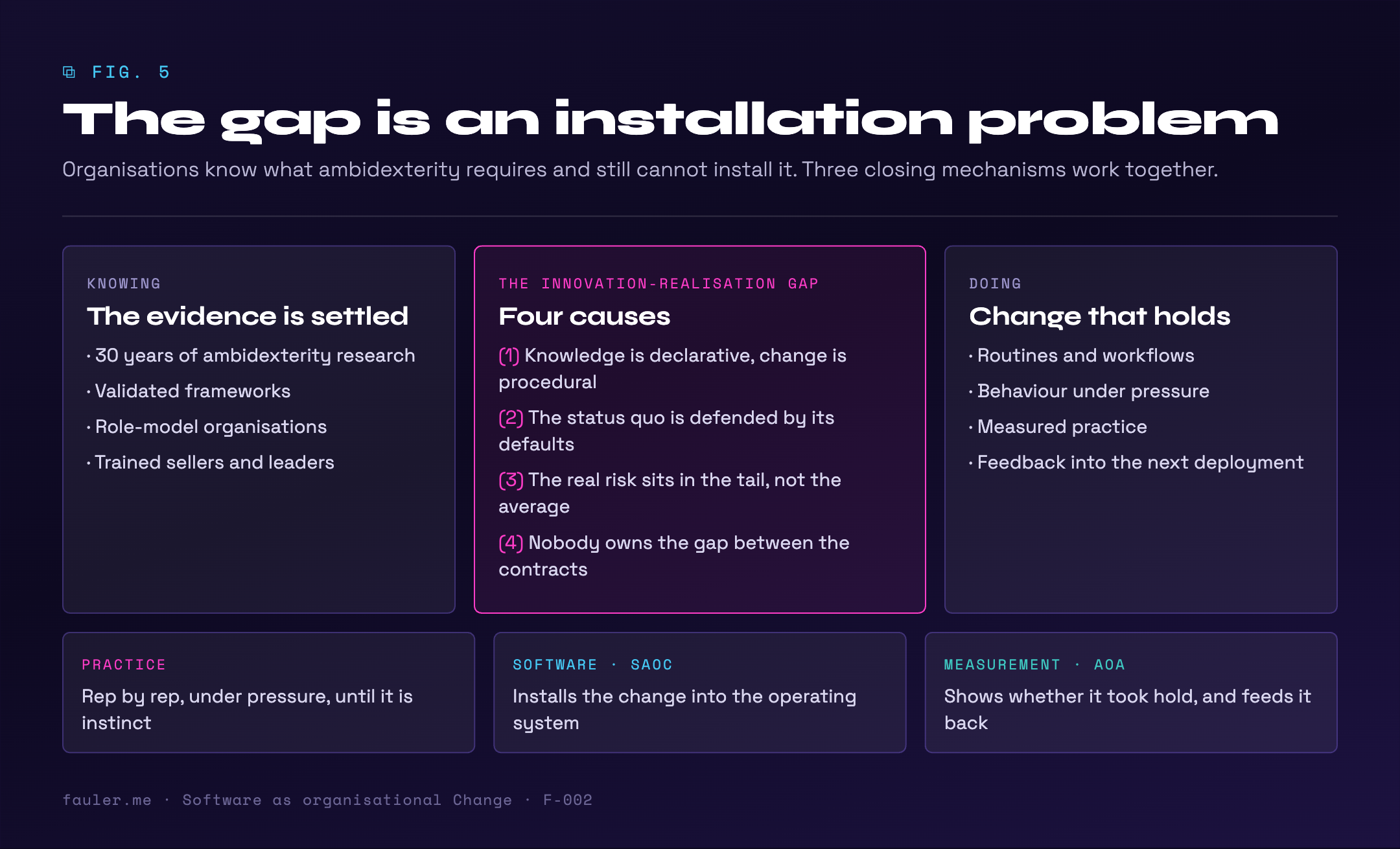
If software is organisational change, the central obstacle is the one Pfeffer and Sutton (2000) called the knowing-doing gap, the persistent failure of organisations to turn knowledge into action. In Realisation Infrastructure I described it as one signature that repeats at every scale, which appears as the knowledge-doing gap in the individual and as the Innovation-Realisation Gap in the organisation. Organisations know what ambidexterity requires and still cannot install it.
Leaders understand opening and closing behaviours and still default to control, and Durisin and Todorova (2012) found that even firms which applied ambidexterity theory correctly on paper implemented it wrong. Perfect knowledge transfer can fail in implementation.
I see four causes. (1) Knowledge is declarative and change is procedural, so knowing what to do and being able to do it under pressure are different capabilities, and only practice converts one into the other. (2) The status quo is defended by its defaults, because every workflow, approval chain and report encodes yesterday’s organisation and keeps running while the strategy deck changes. (3) The real risk stays invisible, since most IT projects land near their budgets while roughly one in six becomes a black swan with cost overruns around 200 percent (Flyvbjerg & Budzier, 2011), and that tail is organisational rather than technical. (4) Nobody owns the gap. The vendor owns the software, IT owns the rollout and HR owns the training, so the organisational change falls between the contracts.
The gap runs through the whole system, and it shows most clearly at one boundary, the one between provider and buyer.
Every Seller of Innovation Is a Change Agent
From a seller’s perspective, the capacity to execute organisational change can become the unique selling proposition of an innovative technology provider, because it addresses what executives actually fear, which is the implementation. The greater the potential organisational impact, the more restrictive decision makers become, so innovative technology competes less with other vendors than with the organisation’s limited capacity for change.
Buying groups now range from five to 16 people across as many as four functions, 74 percent of them show unhealthy conflict during the decision, and groups that reach consensus are 2.5 times more likely to report a high-quality deal (Gartner, 2025). Since buyers spend only 17 percent of their buying time with potential suppliers (Gartner, 2018), enabling internal champions is the main channel.
That changes what selling is. Selling technology-driven innovation is itself an act of change management, and the seller who understands this stops presenting and starts intervening as a Bridger, who connects the buyer’s internal innovation communities with external capabilities and with first-hand experiences of the different future. The provider helps the client “share the driver’s seat” (Hill, Tedards & Wild, 2026), and the engagement grows from a project into an organisational play.
Here the knowing-doing gap takes its most personal form. Most sales professionals have been trained in Solution Selling, Challenger, MEDDICC or Strategic Selling, and yet most of them fail to execute consistently in high-stakes conversations, because communicative impact grows only through deliberate practice.
Sales Kung Fu 销售功夫, the practice school I co-founded, was built to close exactly this gap, and it is the first school of the cybernetic practice described above. It identifies six Decision Gates (Heart, Head, Fire, Hand, Paper and Village), moments of truth in the customer journey where trust is won or lost, and each gate targets one element of the buying group’s loop. Heart and Head reach the goal state, Fire makes the gap between is and ought felt without pushing, and Hand replaces the other side’s prediction with evidence through a proof exercise (does it fit, and can we execute at all). Paper locks the commitment, and Village closes the loop when everyone who can stop the deal confirms it. Sixteen skills move sellers from conscious competence to unconscious mastery, and two bases carry every gate, the Inner Base (the seller’s standing with themselves) and the People Base that grows out of it (the seller’s capacity for relationship). The martial arts metaphor is deliberate, because a practitioner in combat does not think about technique and responds from trained instinct.
At the level of the organisation the same logic produces the Sifu, a master of masters who builds coaching capability across a team. Practising critical moments harder than reality creates a psychologically safe space to fail (Edmondson, 2018), and the same holds inside the buyer for every Architect who has to lead the change once the contract is signed. Frameworks rarely survive these moments. Practised responses do.
Catalysts Design the Game
Architects build readiness inside and Bridgers connect across the boundary, while the Catalyst works at the scale of the ecosystem with Category Design, the practice of framing a problem so clearly that a new way of thinking about it becomes possible (Ramadan et al., 2016; Lochhead et al., 2023).
The discipline has a reputation for winner-takes-all rhetoric, and Play Bigger’s own study of venture-backed US technology companies found that category kings capture 76 percent of the market capitalisation in their space (a hypothesis with strong directional evidence, not settled science). I read that number with the two faces of increasing returns in mind. One face is monopolisation, lock-in and an intermediary that captures the surplus, and the other face is increasing returns that flow back to the players who create them. A category can be a fenced field, or it can be a shared problem frame in which many can play and in which cooperation becomes the winning strategy.
Three elements of Category Design matter for SaoC. A point of view names a problem the world does not yet know it has, which is what commercial teaching asks of every insight at the scale of a conversation (Dixon & Adamson, 2011). Languaging frames, names and claims that problem (Lochhead et al., 2023), and here the name is Software as organisational Change, which I claim by trying to become its most useful contributor. Lightning Strikes, finally, are moments of shared attention that help a market see a problem anew (Kotter, 2014), and they only land when Architects and Bridgers have prepared the ground.
Organisational Fitness Is a Rate
One more idea from the cybernetic tradition sharpens the thesis, especially for public institutions. I describe an organisation’s fitness as a rate, the speed at which it can move on its landscape divided by the speed at which the landscape itself moves. Below 1 the ground outruns the organisation, and above 1 the organisation can choose the next peak before the ground chooses for it.
Four levers move that ratio, and software touches all of them. (1) The sensorium is an organisation’s peripheral vision for weak signals (Day & Schoemaker, 2005), and software can widen or narrow it. (2) Spontaneous task forces form on urgency outside the org chart and need loose coupling, so that a part can move while the whole stays stable, which is the same rule as in Kruse’s valley. (3) Networks across organisations let an ecosystem share its sensorium and move further together. (4) Rhythm matters as much as speed, because firms that change on a regular beat outperform those that change irregularly, even when the irregular ones change more (Klarner & Raisch, 2013). Speed without rhythm is noise.
For a ministry or a city this is the practical form of ambidexterity, because an administration cannot outrun every technology cycle but it can own its rhythm and borrow exploration from its ecosystem.
Software as organisational Change
Let me put the thesis in one place.
My Point of View
Software is organisational change in executable form, and it does far more than support change. Every rollout redistributes decisions, defaults, visibility and networks, and AI makes this impossible to ignore because it takes part in the work.
The Problem
Organisations buy software as products, implement it as IT projects and leave the organisational change to chance. Providers sell features and leave adoption to the customer, and states procure AI and leave the redesign of public administration to the vendor’s defaults. The result is the Innovation-Realisation Gap, with validated knowledge about ambidexterity on one side, unchanged operating systems on the other and a 95 percent problem in between.
What Makes This Different
SaoC uses the adoption moment, the one moment when an organisation budgets for behavioural change, as the vehicle for the organisational design that research prescribes. It designs the four mechanisms on purpose instead of inheriting them from a vendor, and it equips the three roles with practice (Architects lead the change inside, Bridgers practise influence across the boundary, Catalysts frame the category). It also closes the loop with measurement. Ambidextrous Organisation Acceleration (AOA), the research and measurement programme built on SaoC, operationalises ambidexterity across organisational levels and four levers (leadership, networks, culture and psychological safety). SaoC installs the change, and AOA measures whether it took hold. What works flows back into the next deployment.
My Commitment
Today research studies organisations retrospectively, while practitioners intervene without data on whether their interventions work. What is missing is a virtuous cycle in which organisations that invest in ambidexterity contribute data in privacy-preserving ways, researchers validate their models and practitioners receive evidence on what works. One design test decides whether this cycle deserves to exist, and that test is distribution. The surplus (money as well as data, knowledge and attention) has to flow to the organisations that contribute and to the researchers who validate, and never to an extractive intermediary between them. This is what I mean by fairness by design.
This is the research loop of Realisation Infrastructure, and it is not built yet. I am building towards it in the open.
The climb this describes is a staircase from organisations that are scalable for efficiency through organisations that are scalable for learning to organisations that are scalable for co-creation. Every step needs a different capability and a different practice. You do not buy your way up the staircase, you train your way up.
Three Buyers, One Lesson
The SaoC lens changes the questions that every party to a software decision should ask. I see three such parties, and the lesson for each is that the real cost of technology lies in the organisational change required to realise its value, far more than in the licence.
Technology providers differentiate through their capacity to co-create change, and Moore (2014) observed long ago that crossing the chasm to the mainstream requires a whole product, including the organisational change support that makes adoption viable. AI providers learn this fastest, since in the NANDA sample partnerships with external vendors that offered learning-capable, customised tools reached deployment about twice as often as internal builds (Challapally et al., 2025), a correlation and not proof, but a telling one.
Enterprise buyers should evaluate partners as carefully as products. The telling questions are whether a provider understands the organisational design dimension, whether they can act as a Bridger between your teams and outside expertise, and whether they have the candour to surface hard truths about your readiness. Rogers (2003) adds that the compatibility of an innovation with existing values and practices is among the strongest predictors of adoption speed, and in Realisation Infrastructure I described the risk inversion that makes the status quo the real gamble once the world accelerates.
Public buyers procure capability along with systems. A ministry, a city or an agency that introduces AI redesigns how the state exercises discretion, so its procurement should ask the four SaoC questions. Which decisions move from people into the system, and who stays accountable? Which defaults does the vendor set, and who may change them? What becomes visible that was invisible before, and to whom? Which networks between agencies, and between administration and citizens, does the system create or cut? The literacy duty of the AI Act is the floor for this work, and it is best treated as the start of an Architect programme inside the administration, together with partners in the ecosystem who share the exploration (Hietala & Päivärinta, 2025).
One self-diagnostic works for all three. Do we have Architects who build readiness, Bridgers who connect us with outside expertise and Catalysts who create momentum for adoption? If one of them is missing, the software will still install something, only not what we bought it for.

Who This Is For
What if buyers stopped purchasing software and started co-creating transformations? What if states treated every AI deployment as a redesign of public institutions and designed it in the open? What if research and practice closed their own knowing-doing gap through a shared measurement infrastructure?
If you are a technology provider who wants to sell transformations instead of licences, a buyer who wants to co-create instead of procure, a public leader who has understood that an AI strategy is an organisational strategy, or a researcher who wants practice data instead of retrospection, you are exactly who I am looking for. I am not looking for customers here. I am looking for co-creators.
The Question Behind the Question
The question behind the question is not whether software is organisational change. It is whether we have the courage to use the leverage of technology to drive substantial change and build the capacity in people to effectively drive those initiatives.
Are you in? Reach out to me if you want to build this together.
Terms
Software as organisational Change (SaoC) · the thesis that enterprise software is organisational change in executable form, and the practice of using the adoption moment to install the organisational design that research prescribes.
Innovation-Realisation Gap · the knowing-doing gap at the scale of the organisation, where validated knowledge about ambidexterity fails to become routine, workflow and measurable practice.
Ambidextrous Organisation Acceleration (AOA) · the research and measurement programme built on SaoC, which instruments every deployment and feeds what works back into the next one.
Influence by design · influence that reaches the goal state of the other person and passes the surplus, reversibility and durability tests.
Organisational fitness · the speed at which an organisation can move on its landscape divided by the speed at which the landscape moves.
Sources
Bovens, M. and Zouridis, S. (2002). From Street-Level to System-Level Bureaucracies: How Information and Communication Technology is Transforming Administrative Discretion and Constitutional Control. Public Administration Review, 62(2), 174–184. DOI: 10.1111/0033-3352.00168
Bower, J.L. and Christensen, C.M. (1995). Disruptive Technologies: Catching the Wave. Harvard Business Review, 73(1), 43–53.
Bresnahan, T.F., Brynjolfsson, E. and Hitt, L.M. (2002). Information Technology, Workplace Organization, and the Demand for Skilled Labor: Firm-Level Evidence. The Quarterly Journal of Economics, 117(1), 339–376. DOI: 10.1162/003355302753399526
Brynjolfsson, E., Li, D. and Raymond, L. (2025). Generative AI at Work. The Quarterly Journal of Economics, 140(2), 889–942. DOI: 10.1093/qje/qjae044
Brynjolfsson, E., Rock, D. and Syverson, C. (2021). The Productivity J-Curve: How Intangibles Complement General Purpose Technologies. American Economic Journal: Macroeconomics, 13(1), 333–372. DOI: 10.1257/mac.20180386
Burt, R.S. (2004). Structural Holes and Good Ideas. American Journal of Sociology, 110(2), 349–399. DOI: 10.1086/421787
Carver, C.S. and Scheier, M.F. (1998). On the Self-Regulation of Behavior. Cambridge: Cambridge University Press.
Centola, D., Becker, J., Brackbill, D. and Baronchelli, A. (2018). Experimental evidence for tipping points in social convention. Science, 360(6393), 1116–1119. DOI: 10.1126/science.aas8827
Challapally, A., Pease, C., Raskar, R. and Chari, P. (2025). The GenAI Divide: State of AI in Business 2025. MIT NANDA, July 2025.
Christensen, C.M. (1997). The Innovator’s Dilemma: When New Technologies Cause Great Firms to Fail. Boston, MA: Harvard Business School Press.
Cross, R. (2021). Beyond Collaboration Overload. Boston, MA: Harvard Business Review Press.
Day, G.S. and Schoemaker, P.J.H. (2005). Scanning the Periphery. Harvard Business Review, November 2005. hbr.org
Dixon, M. and Adamson, B. (2011). The Challenger Sale: Taking Control of the Customer Conversation. New York: Portfolio/Penguin.
Durisin, B. and Todorova, G. (2012). A Study of the Performativity of the “Ambidextrous Organizations” Theory: Neither Lost in nor Lost before Translation. Journal of Product Innovation Management. DOI: 10.1111/j.1540-5885.2012.00981.x
Edmondson, A.C. (1999). Psychological Safety and Learning Behavior in Work Teams. Administrative Science Quarterly, 44(2), 350–383. DOI: 10.2307/2666999
Edmondson, A.C. (2018). The Fearless Organization. Hoboken, NJ: John Wiley & Sons.
Ehret, S., Constantino, S.M., Weber, E.U., Efferson, C. and Vogt, S. (2022). Group identities can undermine social tipping after intervention. Nature Human Behaviour, 6(12), 1669–1679. DOI: 10.1038/s41562-022-01440-5
Flyvbjerg, B. and Budzier, A. (2011). Why Your IT Project May Be Riskier Than You Think. Harvard Business Review, 89(9), September 2011. hbr.org
Gartner (2018). The B2B Buying Journey. Gartner for Sales research. gartner.com
Gartner (2025). Gartner Sales Survey Finds 74% of B2B Buyer Teams Demonstrate “Unhealthy Conflict” During the Decision Process. Gartner Newsroom, 7 May 2025. gartner.com
Gibson, C.B. and Birkinshaw, J. (2004). The Antecedents, Consequences, and Mediating Role of Organizational Ambidexterity. Academy of Management Journal, 47(2), 209–226. DOI: 10.5465/20159573
Hagel, J. III and Brown, J.S. (2017). Great Businesses Scale Their Learning, Not Just Their Operations. Harvard Business Review, 7 June 2017. hbr.org
Haken, H. (1977). Synergetics: An Introduction. Berlin: Springer.
Hietala, H. and Päivärinta, T. (2025). Governing collective ambidexterity: Antecedents, mechanisms, and outcomes in digital service ecosystems. Government Information Quarterly, 42(1), 102001. DOI: 10.1016/j.giq.2024.102001
Hill, L.A., Brandeau, G., Truelove, E. and Lineback, K. (2014). Collective Genius: The Art and Practice of Leading Innovation. Boston, MA: Harvard Business Review Press.
Hill, L.A., Tedards, E. and Wild, J. (2026). Genius at Scale: How Great Leaders Drive Innovation. Boston, MA: Harvard Business Review Press.
Joyal-Desmarais, K., Scharmer, A.K., Madzelan, M.K., See, J.V., Rothman, A.J. and Snyder, M. (2022). Appealing to motivation to change attitudes, intentions, and behavior: A systematic review and meta-analysis of 702 experimental tests of the effects of motivational message matching on persuasion. Psychological Bulletin, 148(7-8), 465–517. DOI: 10.1037/bul0000377
Junni, P., Sarala, R.M., Taras, V. and Tarba, S.Y. (2013). Organizational Ambidexterity and Performance: A Meta-Analysis. Academy of Management Perspectives, 27(4). DOI: 10.5465/amp.2012.0015
Kelman, H.C. (1958). Compliance, identification, and internalization: Three processes of attitude change. Journal of Conflict Resolution, 2(1), 51–60. DOI: 10.1177/002200275800200106
Klarner, P. and Raisch, S. (2013). Move to the Beat: Rhythms of Change and Firm Performance. Academy of Management Journal, 56(1), 160–184. DOI: 10.5465/amj.2010.0767
Kotter, J.P. (2014). Accelerate: Building Strategic Agility for a Faster-Moving World. Boston, MA: Harvard Business Review Press.
Kruse, P. (2004). next practice. Erfolgreiches Management von Instabilität. Offenbach: GABAL.
Kwan, J.L., Lo, L., Ferguson, J. et al. (2020). Computerised clinical decision support systems and absolute improvements in care: meta-analysis of controlled clinical trials. BMJ, 370:m3216. DOI: 10.1136/bmj.m3216
Lee, S., Han, S., Cheong, M., Kim, S.L. and Yun, S. (2017). How do I get my way? A meta-analytic review of research on influence tactics. The Leadership Quarterly, 28(1), 210–228. DOI: 10.1016/j.leaqua.2016.11.001
Lessig, L. (1999). Code and Other Laws of Cyberspace. New York: Basic Books.
Li, Z. and Shi, J. (2025). Message effects on psychological reactance: meta-analyses. Human Communication Research, 52(1), 38–52 (online 2025, print 2026). DOI: 10.1093/hcr/hqaf016
Lochhead, C., Yoon, E., Cole, N. and Kirsch, K. (2023). The 22 Laws of Category Design. Category Pirates Publishing.
Low, W.R., Sandercock, G.R.H., Freeman, P., Winter, M.E., Butt, J. and Maynard, I. (2020). Pressure training for performance domains: A meta-analysis. Sport, Exercise, and Performance Psychology. DOI: 10.1037/spy0000202
Madrian, B.C. and Shea, D.F. (2001). The Power of Suggestion: Inertia in 401(k) Participation and Savings Behavior. The Quarterly Journal of Economics, 116(4), 1149–1187. DOI: 10.1162/003355301753265543
Maples, M. Jr. and Ziebelman, P. (2024). Pattern Breakers: Why Some Start-Ups Change the Future. New York: PublicAffairs.
March, J.G. (1991). Exploration and Exploitation in Organizational Learning. Organization Science, 2(1), 71–87. DOI: 10.1287/orsc.2.1.71
Marín-Idárraga, D.A. et al. (2025). Ambidexterity and innovation: a systematic and meta-analytic approach to mediating effects on performance. Technology Analysis & Strategic Management. DOI: 10.1080/09537325.2025.2464885
Mathieu, J.E., Heffner, T.S., Goodwin, G.F., Salas, E. and Cannon-Bowers, J.A. (2000). The influence of shared mental models on team process and performance. Journal of Applied Psychology, 85(2), 273–283. DOI: 10.1037/0021-9010.85.2.273
Mergel, I., Edelmann, N. and Haug, N. (2019). Defining digital transformation: Results from expert interviews. Government Information Quarterly, 36(4), 101385. DOI: 10.1016/j.giq.2019.06.002
Mom, T.J.M., van den Bosch, F.A.J. and Volberda, H.W. (2009). Understanding Variation in Managers’ Ambidexterity. Organization Science, 20(4), 812–828. DOI: 10.1287/orsc.1090.0427
Moore, G.A. (2014). Crossing the Chasm (3rd ed.). New York: Harper Business.
O’Reilly, C.A. and Tushman, M.L. (2004). The Ambidextrous Organization. Harvard Business Review, 82(4), 74–81.
O’Reilly, C.A. and Tushman, M.L. (2013). Organizational Ambidexterity: Past, Present, and Future. Academy of Management Perspectives, 27(4). DOI: 10.5465/amp.2013.0025
O’Reilly, C.A. and Tushman, M.L. (2021). Lead and Disrupt: How to Solve the Innovator’s Dilemma (2nd ed.). Stanford, CA: Stanford University Press.
Pfeffer, J. and Sutton, R.I. (2000). The Knowing-Doing Gap: How Smart Companies Turn Knowledge into Action. Boston, MA: Harvard Business School Press.
Raisch, S. and Birkinshaw, J. (2008). Organizational Ambidexterity: Antecedents, Outcomes, and Moderators. Journal of Management, 34(3), 375–409. DOI: 10.1177/0149206308316058
Ramadan, A., Peterson, D., Lochhead, C. and Maney, K. (2016). Play Bigger: How Pirates, Dreamers, and Innovators Create and Dominate Markets. New York: Harper Business.
Regulation (EU) 2024/1689 of the European Parliament and of the Council of 13 June 2024 laying down harmonised rules on artificial intelligence (Artificial Intelligence Act). Official Journal of the European Union, L, 12 July 2024. eur-lex.europa.eu
Rogers, E.M. (2003). Diffusion of Innovations (5th ed.). New York: Free Press.
Roshanov, P.S. et al. (2013). Features of effective computerised clinical decision support systems: meta-regression of 162 randomised trials. BMJ, 346:f657. DOI: 10.1136/bmj.f657
Rosing, K., Frese, M. and Bausch, A. (2011). Explaining the heterogeneity of the leadership-innovation relationship: Ambidextrous leadership. The Leadership Quarterly, 22(5), 956–974. DOI: 10.1016/j.leaqua.2011.07.014
Samuelson, W. and Zeckhauser, R. (1988). Status quo bias in decision making. Journal of Risk and Uncertainty, 1(1), 7–59. DOI: 10.1007/BF00055564
Schiepek, G.K., Tominschek, I. and Heinzel, S. (2014). Self-organization in psychotherapy: testing the synergetic model of change processes. Frontiers in Psychology, 5, 1089. DOI: 10.3389/fpsyg.2014.01089
Simsek, Z. (2009). Organizational Ambidexterity: Towards a Multilevel Understanding. Journal of Management Studies, 46(4), 597–624. DOI: 10.1111/j.1467-6486.2009.00828.x
Straub, D., Kuhnecke, F. and Kirchmann, T. (2013). Change Management: Das Zugvogel-Prinzip. München: Carl Hanser Verlag.
Wang, C.L. and Rafiq, M. (2014). Ambidextrous Organizational Culture, Contextual Ambidexterity and New Product Innovation. British Journal of Management, 25(1), 58–76. DOI: 10.1111/j.1467-8551.2012.00832.x
Weiß, M., Gollwitzer, M. and Hewig, J. (2023). Social influence and external feedback control in humans. F1000Research, 12, 438. DOI: 10.12688/f1000research.133295.1
© 2026 Andreas Fauler · Artwork by Totemical · Imprint · Privacy